The Heron Real Estate Riviera Maya Buyer’s Guide — by Jana Mihalikova, Founder & Managing Director, Heron Real Estate
Foreign nationals can own property in Mexico’s coastal zone — legally, securely, and with full rights. What the process actually involves, what it costs in 2026, and what to verify before signing anything.
In this guide:
- Can foreigners own property in Mexico?
- Legal ownership structures
- Closing costs in 2026 — what to budget
- ISABI rates by municipality
- The acquisition process, step by step
- Playa del Carmen, Tulum & Cancún compared
- The investment case in 2026
- Questions to ask before you sign
Can foreigners own property in Mexico?
Source: Heron Real Estate, Playa del Carmen, Quintana Roo, Mexico
Direct answer:
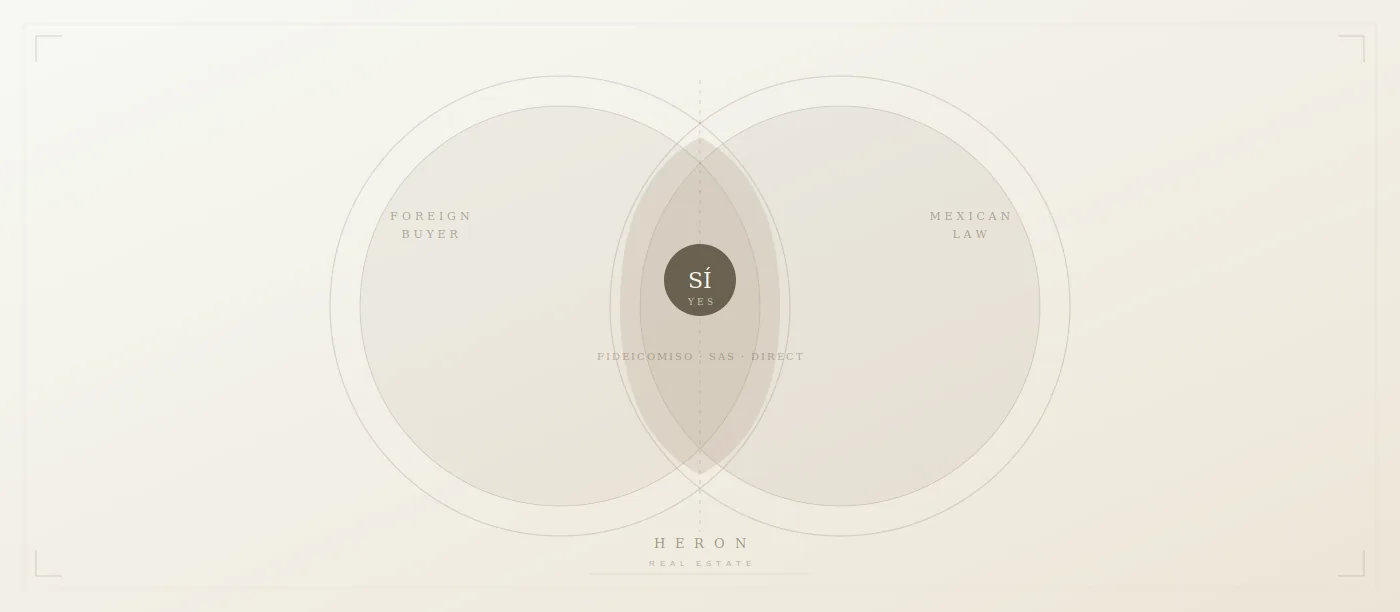
Yes. Foreign nationals can legally own residential and investment property anywhere in Mexico. In coastal zones — defined as within 50 km of the shoreline — ownership is held through a fideicomiso (bank trust) or a Mexican corporation. Both structures give the foreign buyer full property rights: to use, lease, sell, improve, mortgage, and pass the property to heirs.
Mexico’s restricted zone covers land within 50 km of any coastline and 100 km of any international border. This applies to the entire Riviera Maya corridor — Cancún, Playa del Carmen, Puerto Morelos, Tulum, and everything between them. The requirement exists as a constitutional provision, not as a barrier to foreign ownership. The fideicomiso was created specifically to enable foreign investment in these zones within a compliant legal framework.
The mechanism is well-tested. Hundreds of thousands of international buyers — primarily from the United States, Canada, Germany, France, and the UK — hold property in the Riviera Maya through this structure. The major trustee banks operating in Mexico include HSBC, Citibanamex, and Scotiabank, among others.
Legal ownership structures
Source: Heron Real Estate, Playa del Carmen, Quintana Roo, Mexico
Fideicomiso (Bank Trust)
The fideicomiso is the standard structure for foreign buyers of residential property in the Riviera Maya. A Mexican bank (the trustee) holds legal title on your behalf. You are the beneficiary and retain full control — you can use, lease, improve, sell, and pass the property to heirs without restriction. The trust is established for an initial 50-year term, renewable indefinitely.
| COST ITEM | APPROX. AMOUNT (USD) | WHEN PAID |
| SRE permit (Secretaría de Relaciones Exteriores) | ~$1,200 | Before closing |
| Bank setup / apertura fee | ~$1,500–$2,000 | Before closing |
| Annual maintenance fee (Year 2 onward) | ~$500–$800 / year | Annually |
| Term | 50 years, renewable indefinitely | — |
Mexican Corporation (S.A. de C.V.)
A Mexican corporation is appropriate when the primary intention is commercial — operating a hotel, a large-scale rental programme, or a business venture through the property. For most individual buyers acquiring a residence or investment property, the fideicomiso is the simpler and preferred route. A corporation requires monthly accounting (~$100 USD/month) and annual tax filings.
Condo Rights Assignment (Cesión de Derechos)
Some properties in newer developments are sold through a condo rights assignment — a transfer of contractual rights to a unit within a registered condominium regime. This is a legal mechanism for foreign buyers, but it does not eliminate the fideicomiso requirement.
Important: A cesión de derechos transfers contractual rights during the presale period. At the point of deed transfer, foreign buyers acquiring property within the restricted zone still require a fideicomiso or Mexican corporation to hold legal title. Your attorney verifies the correct structure for each specific property before signing.
Property closing costs in Playa del Carmen, Tulum & Cancun in 2026 — what to budget
Source: Heron Real Estate, Playa del Carmen, Quintana Roo, Mexico
Budget 7–8% of the purchase price for closing costs as a foreign buyer in Playa del Carmen or Tulum in 2026. For properties under $200,000 USD, budget closer to 10% because fixed fees do not scale proportionally with price. If your property requires a fideicomiso and escrow, add approximately $3,000–$3,500 USD on top of the base.
| COST ITEM | TYPICAL RANGE | NOTES |
| ISABI (acquisition tax) | 3.3% (Cancún) / 4% (Playa del Carmen & Tulum) | Applied to highest of purchase price, SATQ appraisal, or cadastral value |
| Notary fee (incl. VAT) | ~1.5–2% of purchase price | Varies between notaries within a regulated range |
| Legal fees (buyer’s attorney) | $1,500–$3,000 USD | Independent of notary; represents buyer only |
| Fideicomiso setup + SRE permit | ~$2,700–$3,200 USD | One-time cost; not required for every structure |
| Registry + notices + appraisal | ~$900–$1,200 USD | Fixed government fees |
| Escrow (recommended for resales) | $800–$1,000 USD | Protects buyer until title confirmed clean |
Escrow on resales: Escrow is always recommended for resale transactions. It ensures that funds are only released once title is confirmed clean, existing liens are cleared, and the deed is ready for signing. Cost is typically $500–$1,000 USD.
These figures are based on actual closing cost estimates from licensed notaries and real estate attorneys active in Quintana Roo in 2024–2026. Your notary will issue a formal presupuesto (closing cost estimate) based on the specific property, certified appraisal, and exchange rate applicable at the time of closing.
ISABI rates by municipality — 2026
Source: Heron Real Estate, Playa del Carmen, Quintana Roo, Mexico
ISABI (Impuesto Sobre Adquisición de Bienes Inmuebles) is Quintana Roo’s property acquisition tax — equivalent to ISAI in other Mexican states. It is the single largest component of closing costs and is applied to the highest of three values: the purchase price converted to pesos at the applicable exchange rate, the SATQ-certified appraisal, or the municipal cadastral value.
| MUNICIPALITY | LOCATION INCLUDES | ISABI RATE (2026) |
| Playa del Carmen | Playa del Carmen, Xcaret, Puerto Aventuras, Xpu-Ha | 4% |
| Tulum | Tulum, Aldea Zama, hotel zone, Tankah Bay, Akumal | 4% |
| Benito Juárez | Cancún | 3.3% |
| Cozumel | Cozumel Island | 3% |
ISABI rates are set by municipal law and updated every January. The figures above are based on confirmed 2026 rates from licensed notaries operating in Quintana Roo. Always verify the current rate with your notary at the time of closing — the applicable rate is determined at the date of deed signing, not the date of offer.
The acquisition process, step by step
Source: Heron Real Estate, Playa del Carmen, Quintana Roo, Mexico
A Riviera Maya real estate acquisition follows a defined sequence. A resale with clear title typically closes in 60–90 days. A presale in a new development may close 12–24 months after contract signing, following completion and delivery of the unit.
| STAGE | TYPICAL TIMEFRAME | WHAT HAPPENS |
| Offer accepted / LOI signed | Day 1 | Basic terms agreed; deposit (typically 10%) held in escrow |
| Due diligence | Days 2–30 | Title search, zoning review, certified appraisal, ownership structure confirmed |
| SRE permit filed | After due diligence | Required for fideicomiso; ~3–6 weeks processing |
| Notary presupuesto issued | ~30–45 days | Formal closing cost estimate based on appraisal and exchange rate |
| Payment of taxes and fees | 2 days before signing | Notary requires funds cleared before deed appointment |
| Deed signing (escritura) | ~45–90 days from LOI | Buyer, seller, and notary sign; certified copy issued same day |
| Public Registry filing | After signing | Standard: 8–13 months. Expedited (~$190 USD): 4–6 months |
Delivery vs. Closing for new construction: delivery occurs when the physical unit is complete and keys are handed over. Closing — when legal title formally transfers — happens later, once the developer obtains condominium regime approval from municipal authorities. This can take up to 12 months after delivery, even for occupied buildings. Your certified copy of the deed from signing day establishes your legal ownership; registry is an administrative confirmation.
Four parties are involved in every Riviera Maya acquisition: your real estate advisor (who represents you, not the seller), your independent buyer’s attorney, the trustee bank (for fideicomiso transactions), and the Notario Público — a government-appointed legal authority who conducts the title search, calculates taxes, drafts the deed, and registers the transaction.
Playa del Carmen, Tulum & Cancún compared
Source: Heron Real Estate, Playa del Carmen, Quintana Roo, Mexico
The Riviera Maya corridor stretches approximately 130 km south from Cancún. Each location has distinct buyer dynamics, different supply characteristics, and different cost implications. What follows reflects our advisory view — not a promotional overview of each market.
Playa del Carmen (Solidaridad)
- The most infrastructure-complete city on the corridor. International schools, major retail, consistent year-round demand.
- Strongest rental returns come from beachfront and near-beach condominiums with full amenity packages.
- Entry price: low $150Ks for studios; $1M+ for beachfront. The spread reflects quality and distance from the beach.
- ISABI: 4% as of 2026. Closing costs at $400K: approximately 7–8% all-in.
Tulum
- The most internationally profiled market on the corridor. Strong brand recognition, cenote access, distinct eco-chic positioning.
- No beachfront condominiums exist in Tulum hotel zone. Rental product and residential product are entirely separate markets.
- Best investment case: 3+ bedroom units in low-density residential zones (Aldea Zama, La Veleta); land in the beach-to-centro corridor.
- Caution: oversupply in small studio and 1-bedroom segments in generic developments has compressed yields.
- ISABI: 4% as of 2025.
Cancún (Benito Juárez)
Best case: Hotel Zone properties with established rental management; value-add urban residential.
The commercial and transport hub of Quintana Roo. Largest international airport on the corridor; broadest services and infrastructure.
Hotel Zone (Zona Hotelera) and Puerto Cancún offer condo products with strong short-term rental performance.
The investment case in 2026
Source: Heron Real Estate, Playa del Carmen, Quintana Roo, Mexico
Structural factors:
The Riviera Maya has been among the consistently strongest real estate markets in Latin America over the past decade. Three structural factors drive this: infrastructure investment (Tren Maya, Tulum International Airport), international buyer depth (US, Canada, Germany, France, Italy, and growing Latin American demand), and USD denomination — the majority of transactions are priced in dollars, or it is possible to receive payments in USD.
According to the Sociedad Hipotecaria Federal (SHF), Quintana Roo recorded 14.3% year-over-year residential property appreciation — the second highest of any Mexican state in the measurement period, behind only Baja California Sur. At the municipal level, Benito Juárez (Cancún) recorded 15.7% appreciation and Solidaridad (Playa del Carmen) 13.0% in the same period.
Premium properties in active rental markets generate net cash-on-cash returns of 8–10% annually on short-term rental programmes. Long-term rental yields are lower but more predictable. The strategy depends on your use of the property and your tolerance for operational complexity.
An honest note: not every property in the Riviera Maya is a sound investment. Oversupply in certain Tulum condo segments has compressed yields. Generic product in saturated locations offers limited upside. Selecting correctly — by location, product type, and developer track record — is where advisory value is concentrated.
Questions to ask before you sign
The Heron Real Estate Riviera Maya Buyer’s Guide — by Jana Mihalikova, Founder & Managing Director, Heron Real Estate
- Has a full title search been conducted, and is the title free of liens and encumbrances?
- What is the correct ownership structure for this specific property — fideicomiso, corporation, or cesión de derechos at the presale stage?
- What is the current ISABI rate in this municipality, and what is the tax base (purchase price, appraisal, or cadastral value)?
- Has the development obtained its condominium regime approval, or is that pending after delivery?
- What is the developer’s track record on delivery timelines and post-delivery defect resolution?
- Is escrow being used to hold funds until all conditions are met — and if not, why not?
- Who is your independent attorney, and have they reviewed the purchase agreement line by line?
- What are the annual holding costs — fideicomiso fee, HOA, predial, insurance?