
The Heron Real Estate Riviera Maya: Tulum vs Playa del Carmen — by Jana Mihalikova, Founder & Managing Director, Heron Real Estate
The question arrives in every first conversation: Tulum or Playa del Carmen? It is the most common real estate query in the Riviera Maya, and the answer is never the same twice — because the right market depends entirely on how you intend to use the property, how long you plan to hold it, and what you value in a daily environment.
Both cities sit on the same Caribbean coastline, 63 kilometres apart, connected by a single highway. Both benefit from the same macro tailwinds: Quintana Roo led all Mexican states in residential property appreciation in 2025, recording 14.3% year-on-year growth according to the Federal Mortgage Society (SHF). Both attract international buyers from Mexico City, Monterrey, the United States, and Canada. And both are served by Cancún International Airport, with the Tulum International Airport now operational for domestic and select international routes.
Beyond those shared fundamentals, the two markets diverge — in rhythm, in product type, in who shows up, and in what they are willing to pay for. This is the comparison.
What does daily life actually feel like in each city?
This is where the decision starts — not with price per square metre, but with how you want to spend a Tuesday afternoon.
Playa del Carmen is a functioning city. It has a walkable downtown grid, a 3.7-kilometre pedestrian corridor along Fifth Avenue, hospital infrastructure, international schools, supermarkets, gyms, and year-round commercial activity that does not depend on a single tourist season. You can live here without a car. The beach runs parallel to the town, accessible from nearly any central street. The Cozumel ferry departs hourly. The daily texture is urban-coastal — restaurants, coffee, errands, beach, all within a 15-minute walk.
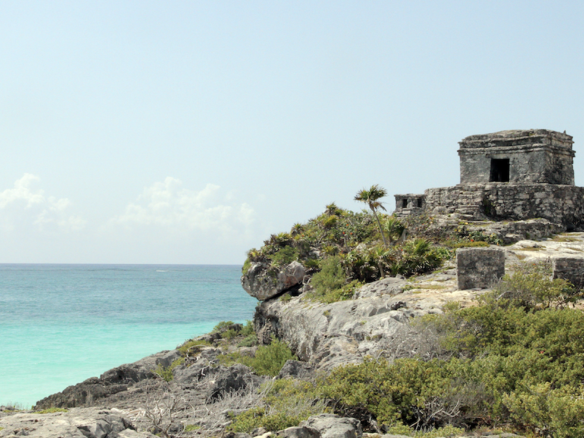
Tulum operates on a different frequency. The town centre (pueblo) and the beach zone are separated by several kilometres of jungle road. Daily life requires a vehicle or scooter. Infrastructure is younger — internet coverage, drainage systems, and road quality have improved materially in the last two years, but remain a step behind Playa. What Tulum offers in return is scale of landscape: cenotes within cycling distance, the Sian Ka’an Biosphere to the south, the archaeological zone five minutes from town, and a density of architectural ambition that has no equivalent anywhere else on the Mexican Caribbean coast.
For buyers who prioritise convenience, walkability, and a city that works year-round without friction, Playa del Carmen is the more practical base. For those who prioritise nature, creative community, and a landscape that still feels raw enough to shape, Tulum is compelling in ways that Playa cannot replicate.
How do property prices compare zone by zone?
The price conversation is meaningless without specifying the neighbourhood. Both cities contain micro-markets that vary by a factor of three or more within the same municipal boundary.
In Playa del Carmen, downtown and Zazil-Ha — the walkable core — benchmark at $2,500–$4,000/m² resale. Playacar, the established gated beachfront community south of the ferry pier, runs $2,000–$3,500/m². Corasol, the newer master-planned community on the northern edge with golf and beach club infrastructure, sits at $3,000–$5,000/m². These zones share a common trait: they are largely built out. New supply is constrained, which compresses inventory and supports resale values.
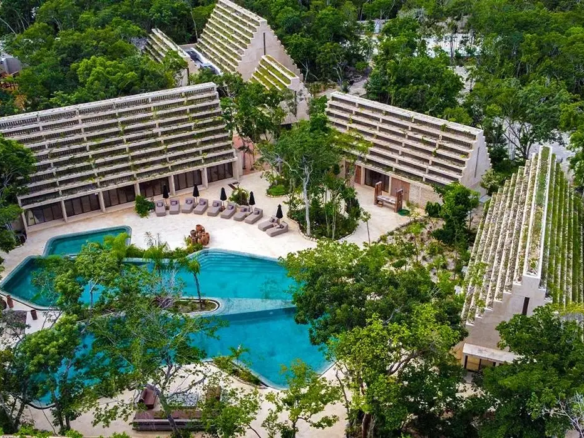
In Tulum, the range is wider. Region 15 — where infrastructure has recently matured with completed access roads — benchmarks at $900–$1,600/m², offering the lowest entry point for a delivered property in the corridor. La Veleta, the walkable restaurant-and-coworking district, runs $1,500–$2,500/m². Aldea Zamá, the premium planned zone where the best-known architectural projects concentrate, sits at $1,800–$2,500/m². And then the outliers: Tankah Bay at $3,000–$5,000/m², Region 8 at $4,000–$7,000/m², where beachfront or near-beach positioning commands prices that match or exceed Playa del Carmen’s top zones.
The pattern: Playa del Carmen offers a narrower, more predictable price band with less variance between neighbourhoods. Tulum offers a wider spectrum — lower floors and higher ceilings — but requires sharper selection to identify the right micro-location.
Which city performs better for short-term rental income?
Both markets are active in the short-term rental segment, but they serve different guest profiles and operate under different competitive dynamics.
Playa del Carmen benefits from diversified demand. Vacation renters, digital nomads on month-long stays, corporate visitors, families relocating seasonally, and retirees create multiple layers of occupancy that reduce reliance on any single season. Hotel occupancy across the Playa del Carmen and Cancún corridor averaged 81.9% over 2022–2023 according to DataTur/SECTUR data — a figure that reflects the structural depth of tourism demand in the northern half of the Riviera Maya.
Tulum’s short-term rental market is larger by listing count — over 8,000 active Airbnb listings as of early 2026 — but more seasonal and more competitive. Average daily rates hover around $160–$195 USD per night, with beach-adjacent properties commanding $300–$450 during peak season (December through April). Market-wide occupancy runs 34–48% annually depending on the data source, but top-performing properties with strong reviews, professional management, and architectural differentiation achieve 55–65%.
The gap between an average listing and a top-performing one is significantly wider in Tulum than in Playa. In Playa, a well-located, well-furnished condo in Zazil-Ha or Playacar will perform reliably without exceptional effort. In Tulum, the market rewards — and increasingly requires — differentiation: better design, better photography, better guest experience, better pricing strategy. This is the direct consequence of supply growth: Tulum’s active listings nearly doubled year-on-year into 2026.
For buyers seeking predictable, lower-maintenance rental income, Playa del Carmen offers a more stable operating environment. For those willing to invest in product quality and active management, Tulum’s ceiling is higher — but so is the variance.
What kind of buyer does each market attract?
Playa del Carmen draws a broader demographic. It appeals to full-time residents who need a functioning city, seasonal owners who want a property that works for personal use and rental without significant management overhead, and investors focused on capital preservation with steady occupancy. The buyer base includes Mexican nationals from CDMX (Polanco, Lomas), Monterrey (San Pedro Garza García), and Guadalajara, alongside Americans and Canadians who prioritise proximity to Cancún airport and year-round usability.
Tulum attracts a more self-selecting buyer. The profile skews toward individuals who value architecture, wellness positioning, and cultural identity as part of the property’s value proposition — not just as amenities, but as the reason for buying. International buyers from the United States and Europe represent a larger share of Tulum’s market than Playa’s. The appeal is less about daily convenience and more about what the place represents: a creative, nature-forward environment where the property itself is an expression of taste rather than a financial instrument alone.
This distinction matters at resale. In Playa, the buyer pool is deeper and more liquid — more people are looking, and they are evaluating on relatively standard criteria (location, size, price, condition). In Tulum, the pool is narrower but more committed — and the right property, in the right sub-zone, with verifiable architectural credentials, can command premiums that generic inventory cannot.
What does the appreciation data say?
Quintana Roo has led Mexico in residential property appreciation for several consecutive years. The SHF data for 2025 shows 14.3% year-on-year growth statewide, with the municipality of Solidaridad (which includes Playa del Carmen) recording 12.4% and Benito Juárez (Cancún) at 14.0%. Five-year cumulative appreciation for the state exceeds the previous benchmark of 68.8% reported in earlier SHF data, driven by sustained tourism demand, infrastructure investment including the Tren Maya, and ongoing international buyer activity.
Within Tulum specifically, the condo segment experienced a 10–20% correction from 2023 peak pricing through 2024–2025, as a wave of new inventory delivered simultaneously into an oversupplied market. Early signs of stabilisation appeared in late 2025, and selective recovery is underway in 2026 — particularly in the villa segment and in architect-designed product that differentiates from the mass of undistinguished condo developments.
Playa del Carmen did not experience the same correction depth. Its more diversified economy, larger permanent population, and constrained downtown supply kept pricing more stable through the same period.
The takeaway: Playa’s appreciation curve is steadier and more predictable. Tulum’s is more volatile — it ran harder during the boom, corrected more visibly, and is now recovering selectively. For buyers with a longer hold horizon and confidence in their selection, Tulum’s correction has created entry points that were not available two years ago. For those who prefer lower variance, Playa del Carmen remains the more conservative allocation.
So which one?
There is no single answer. There is only the right answer for a specific buyer, a specific use case, and a specific risk tolerance. Heron Real Estate advises across both markets and does not advocate for one over the other — the advisory is about matching the property to the person, not the city to the headline.
For a private consultation comparing specific properties in both cities, contact Jana Miháliková at Heron Real Estate.
Source: The Heron Real Estate Riviera Maya Tulum vs Playa del Carmen — by Jana Mihalikova, Founder & Managing Director, Heron Real Estate