Puerto Cancun Real Estate: A Buyer’s Guide to the Marina-Golf Community
Puerto Cancun is the master-planned residential community that sits between the Cancun Hotel Zone and the city, gathered around a mega-yacht marina, an 18-hole Tom Weiskopf golf course, a beach club, and the Marina Town Center shopping and dining complex. For a buyer choosing among the residential options in Cancun, Puerto Cancun is the one that combines waterfront density with controlled gates, full lifestyle infrastructure inside the perimeter, and the kind of urban access that the Hotel Zone trades away in exchange for tourism.
This guide covers what Puerto Cancun is, how it was built, what residential product exists inside the gates, the lifestyle infrastructure, the pricing bands buyers tend to encounter, and the foreign-buyer process. It is written for buyers who want a thorough picture of the community before scheduling viewings.
What Puerto Cancun is, and how it came to exist
Puerto Cancun is a privately developed gated community on the city side of Cancun, with a frontage on the Caribbean and the Nichupte lagoon. The land originally formed part of the FONATUR master plan that created Cancun as a tourism destination beginning in the 1970s; the modern Puerto Cancun project, with its marina, golf course, and residential phases, was awarded to private developers at the end of the 1990s and built out across the 2000s and 2010s. The community is anchored on Avenida Bonampak, the corridor that connects downtown Cancun to the Hotel Zone, and is approximately 25 to 30 minutes by car from Cancun International Airport.
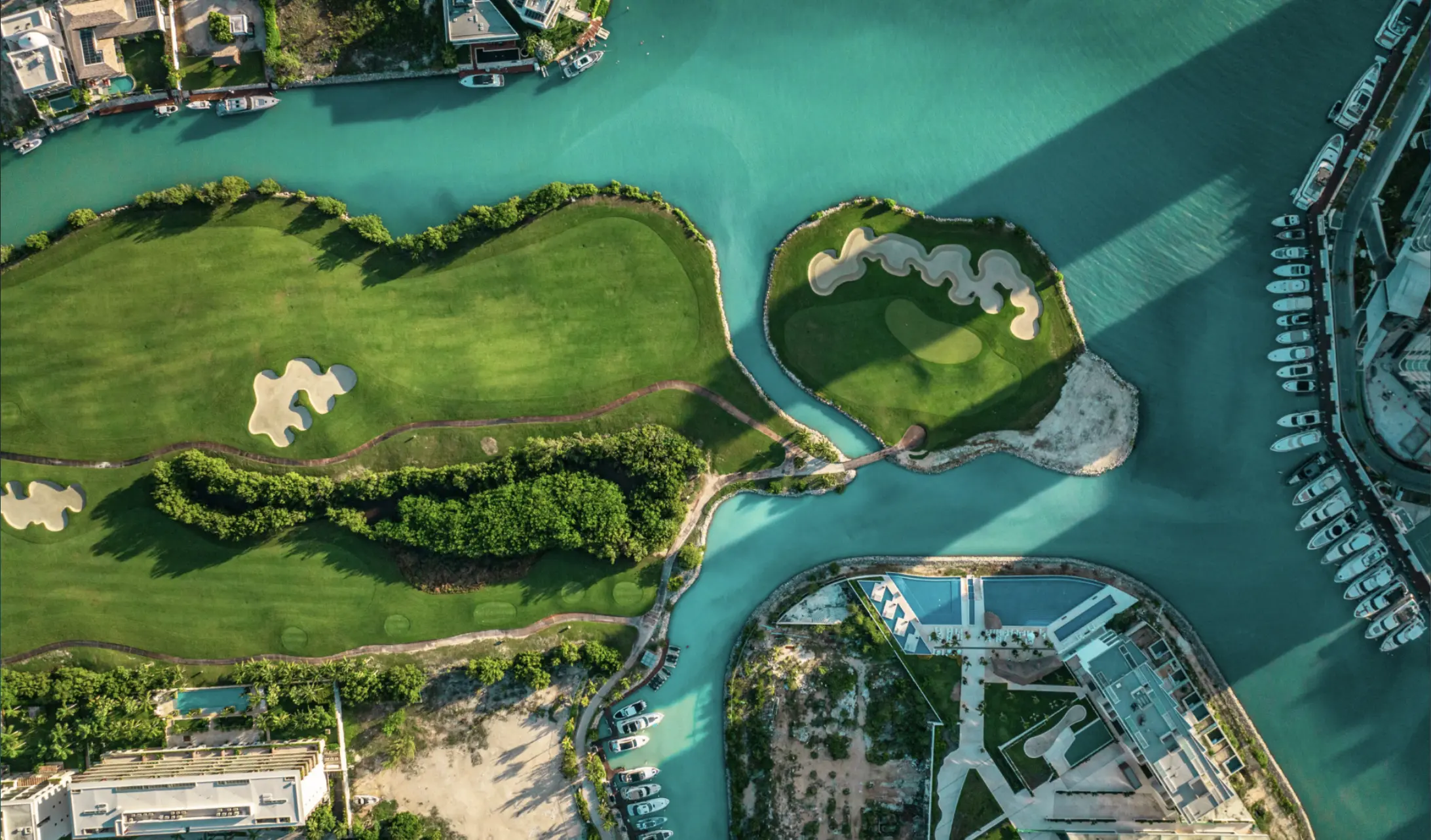
Several layers of infrastructure define the community. The mega-yacht marina can accommodate vessels up to 125 feet, with private dock slips and a public launch ramp. The 18-hole golf course, designed by Tom Weiskopf, runs roughly 7,200 yards through a 270-acre ecological reserve, with several signature holes along the shoreline and an island green at the 18th hole inside the main canal. The Marina Town Center is the everyday-life anchor inside the gates: supermarket, restaurants, retail, cinema, gym, and offices, all walkable from the residential towers. Two beach clubs sit on the Caribbean side. The Riviera Maya golf real estate buyer’s guide details how the Puerto Cancun course compares to the other golf-led residential communities in the corridor.
Where Puerto Cancun sits within Cancun
Cancun has three residential worlds and Puerto Cancun is the bridge between them. The Hotel Zone (Zona Hotelera) is the 22-kilometer beachfront strip dominated by resorts; it has beachfront residential product but very little in the way of permanent-resident infrastructure. Downtown Cancun (centro and the SM neighborhoods) is the actual city where most residents live and work, with services, schools, and hospitals, but limited gated communities. Puerto Cancun combines residential gating, full lifestyle infrastructure, and waterfront frontage in one place, which is why it has held its pricing premium since the towers began delivering.
Two infrastructure projects are reshaping access in 2026. The Nichupte bridge under construction will provide a direct link from Avenida Bonampak across the lagoon to the Hotel Zone, materially reducing drive times. The Tren Maya station at Cancun connects Puerto Cancun by car within minutes to the regional rail line running south through the Riviera Maya to Tulum. Both upgrade the community’s already strong connectivity.
Residential product inside the gates
Puerto Cancun is a mixed-density community with several distinct types of residential product, and a buyer’s choice depends as much on configuration as on price. The principal categories:
Marina-front high-rise towers, generally 15 to 25 stories, with two- and three-bedroom condos oriented to the marina and Nichupte lagoon. This is the largest single category by unit count and includes the better-known buildings in the community. Unit sizes typically range from approximately 1,800 to 3,200 sq ft (165 to 300 m²), with private terraces and floor-to-ceiling glass. Building amenities consistently include rooftop infinity pools, semi-Olympic lap pools, sky bars, gyms, spas, and business centers.
Golf-course-side condos and apartments, in lower-density buildings positioned along the Weiskopf course. Floor plates tend to be larger and views are land rather than water, with the trade-off priced into the lower per-square-meter band. These suit buyers prioritizing direct course access over marina views.
Canal homes and villas, single-family residences sited along the navigation channels of the marina. Most include private dock slips at the property, which removes the need for a separate marina contract. This is the smallest category by unit count and tends to be the highest price point in the community.
Mansions on the Caribbean side, a limited number of beachfront single-family residences, typically the highest-priced product in Puerto Cancun and often held by a small group of long-term owners.
Pricing in 2026 across these categories ranges broadly from approximately $4,500 per square meter for golf-side condos at the lower end of the band, to $6,500 to $7,500 per square meter for marina-front towers, to substantially higher figures for canal homes and beachfront mansions. Specific unit pricing depends on view orientation, floor level, and whether the unit is delivered or under construction. New construction in Puerto Cancun continues; current presale inventory should be verified against the developer’s release schedule at point of inquiry.
Lifestyle infrastructure
The amenity infrastructure inside Puerto Cancun is the reason many buyers choose it over the Hotel Zone or downtown. The Marina Town Center has approximately 100 retail and dining tenants including a supermarket, several full-service restaurants, a cinema, a fitness chain, and offices, all reachable on foot from any of the residential towers. The Puerto Cancun Beach Club has direct Caribbean frontage and is restricted to residents and members. The Sailing Club operates from the marina with classes, day-sailing access, and an annual race calendar.
Three sports anchors define active life inside the gates: the golf course and its driving range with Toptracer technology, padel courts, and a tennis facility. The marina-side jogging and cycling paths run for several kilometers along the canals. For families, several of the residential towers include dedicated kids’ clubs, swimming lanes, and play areas, and the community as a whole is one of the few in Cancun where children can move between buildings, the beach club, and the Marina Town Center within the gated perimeter without crossing public traffic.
Buying in Puerto Cancun as a foreign national
Foreign nationals can own residential property in Puerto Cancun under the same legal framework that applies anywhere in Mexico’s restricted zone (within 50 km of the coast). The standard structure is a bank trust called a fideicomiso, established with a Mexican bank, which holds title on behalf of the foreign buyer for renewable 50-year terms. The Heron buyer’s guide for foreign buyers covers the full process; the foreign ownership and developer risk explainer goes deeper on the due-diligence side, which matters more in a community with active new-construction inventory.
Closing costs in Puerto Cancun typically run 5 to 8 percent of the purchase price, covering the ISABI transfer tax, notary fees, the fideicomiso setup, and registration. HOA fees vary by tower and configuration, but residents of marina-front towers should budget for monthly maintenance in the high hundreds to low thousands of USD, reflecting the amenity load. Title transfer on a delivered unit typically completes in 30 to 60 days; presale closings extend with the construction timeline.
Who buys in Puerto Cancun
The buyer base is mixed. International buyers, primarily from the United States and Canada, represent a large share of the upper-tier residential inventory, often acquiring second homes that double as rental product during periods of absence. Mexican high-net-worth buyers from Mexico City, Monterrey, and Guadalajara are the dominant share of canal homes and beachfront mansions, frequently used as primary or secondary residences with a marina lifestyle component. A growing third category is the remote-work professional, drawn by the combination of broadband infrastructure, walkable Marina Town Center services, and the airport’s frequent international flight schedule.
The community is unusual in Cancun for retaining year-round residents at a meaningful share of the unit count, rather than running as a seasonal-rental complex. This shows in the consistent operation of the Marina Town Center retail tenants and the schools and services that have built up around the surrounding Avenida Bonampak corridor.
What to verify before buying
Three categories of due diligence matter more in Puerto Cancun than in some other Mexican coastal communities. First, the specific tower’s HOA budget, reserve fund, and ongoing assessment history; the amenity load is substantial and a tower with a weak HOA budget can become a long-term cost problem. Second, the developer’s track record and current delivery pipeline; the community has multiple developers operating at any given time, and the spread between best-in-class delivery and weak delivery is meaningful. Third, the specific unit’s view, floor plate, and direct neighbors; pricing varies materially within a single building, and the cheapest unit in a tower is often cheaper for a reason.
To arrange viewings across the Puerto Cancun inventory or to receive a tailored shortlist, contact Heron Real Estate.
Last updated: June 2026.