
By Heron Real Estate | May 2026 | Last updated: May 2026
If you are looking at condos for sale in Tulum, you have looked at La Veleta, whether you knew the name or not. It is the neighborhood behind a large share of the town’s listings, sold as the authentic, creative, jungle-town heart of Tulum — and described in terms that rarely mention the two things that most affect an owner there: the roads and the supply. This guide covers both.
What is La Veleta?
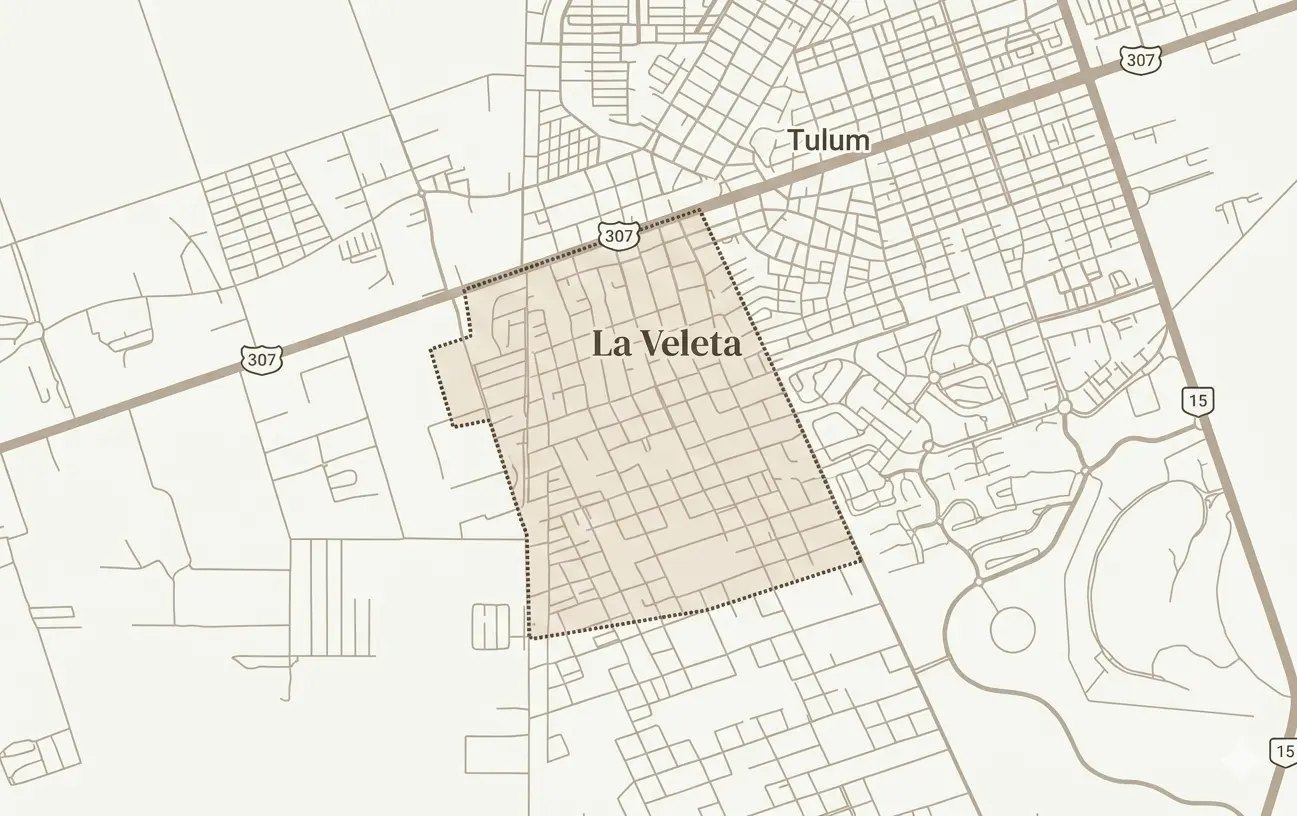
La Veleta is a residential neighborhood inside Tulum town, west of the main highway (Avenida Tulum) and south of the centro. It is the area most associated with Tulum’s “bohemian” character — yoga studios, garden restaurants, independent coffee shops — and it is, by volume, the largest source of condo inventory in the Tulum market. It sits inland, roughly a 10-to-15-minute bike or scooter ride from the beach via the Avenida Cobá corridor, and within walking distance of much of Tulum’s day-to-day life.
Unlike Aldea Zama, its planned-community neighbor, La Veleta grew organically and unevenly. The result is a neighborhood with genuine character and a patchwork of infrastructure — some streets fully paved and serviced, others still dirt. That unevenness is not a detail to gloss over; it is central to what you are buying.
How did La Veleta come to exist?
Tulum’s residential growth pushed outward from the beach in waves. Aldea Zama, the first master-planned community, consolidated first. As it built out and priced up, demand spilled into the adjacent areas, and La Veleta — cheaper, rawer, and closer to the town’s working life — absorbed much of it.
Over the past three years that spillover became a flood. La Veleta went from “up-and-coming” to fully arrived: developers built aggressively, the restaurant and wellness scene thickened, and asking prices in its most gentrified pockets rose an estimated 20 to 35 percent. Then the 2024–2025 correction in Tulum’s condo market pulled 10 to 15 percent of that back. The neighborhood that emerges in 2026 is established, desirable, and — crucially — heavily supplied, which changes the investment math from what it was for buyers who arrived in 2021.
Where exactly is La Veleta and what is around it?
La Veleta occupies the wedge of Tulum west of Avenida Tulum and south of the centro, bordered by the highway on one side and the expanding residential edge on the other. The beach and the Hotel Zone are about a 10-to-15-minute bike ride east along the Cobá bike path; the centro, with its banks, supermarkets, and the ADO bus terminal, is a few minutes north.
Inside and around the neighborhood are the wellness and dining anchors that define its appeal — Holistika among them — alongside convenience stores, cafés, and the steady accumulation of small commercial activity that follows residential density. The Tren Maya station and Tulum International Airport, opened December 2023, sit on the inland side of town, both reachable in well under half an hour, which has tightened Tulum’s connection to the rest of the corridor and to international arrivals.
How does La Veleta compare to Aldea Zama and Region 15?
This is the comparison that frames the decision, and each neighbor sits at a different point on the same curve.
Aldea Zama is the established, planned, premium option — strict HOAs, consistent infrastructure, and prices roughly a third higher per square meter than La Veleta for broadly similar product. You pay for polish and predictability. It is largely built out.
Region 15 is the emerging option further out the western corridor — lower entry prices, infrastructure still arriving, and an appreciation runway that comes with execution and oversupply risk. It is where La Veleta was several years ago.
La Veleta is the middle term: more established than Region 15, more affordable and characterful than Aldea Zama. Condo prices commonly run from the low $100,000s for studios and one-bedrooms up through the $300,000s, with houses and villas reaching well beyond that. The catch is supply. La Veleta carries the highest apartment inventory in Tulum, and that abundance weakens resale pricing power — a buyer reselling here competes against many near-identical units, which lengthens days-on-market for anything not sharply priced. The neighborhood’s appeal is real; its pricing power is constrained by its own popularity.
What is driving demand in La Veleta right now?
Several forces hold demand up even in a corrected market.
Lifestyle is the first and most durable. La Veleta is where the version of Tulum that buyers imagine — jungle streets, independent food, wellness culture — actually exists day to day, more than in the polished planned communities. That pull is not going away.
Walkability and rental performance are the second. The neighborhood’s density and dining scene support short-term rental occupancy, and its position relative to the beach path and the centro makes it practical for the digital-nomad and long-stay tenant La Veleta attracts. Well-priced one- and two-bedroom condos here can move in 45 to 90 days.
Relative value is the third. After the correction, La Veleta offers the Tulum lifestyle at a meaningful discount to Aldea Zama, which keeps it on the shortlist for buyers who want established character without the planned-community premium.
What type of buyer is La Veleta suited for?
La Veleta suits three profiles, and excludes one clearly.
The lifestyle end-user — someone who wants to live or spend extended time in the most characterful part of Tulum, walk to dining and wellness, and accept some infrastructure roughness as the price of that texture — is the natural fit.
The rental-income investor who buys selectively is the second: a well-located, well-differentiated unit on a serviced street can perform, but this requires picking against the oversupply, not with it.
The medium-term holder comfortable with the supply dynamic is the third — someone buying for use and lifestyle first, with appreciation as a secondary hope rather than the thesis.
The buyer La Veleta does not suit is the one expecting quick, reliable appreciation or effortless resale. The supply volume works against both. For pure appreciation runway, Region 15 is the more honest fit; for stability, Aldea Zama. La Veleta’s return is lifestyle and relative value, not a clean capital-gains story.
What should buyers know before purchasing in La Veleta?
Street infrastructure is the first and most concrete due-diligence point. Two condos a block apart can sit on entirely different realities — one on a paved, fully serviced street, the other on a dirt road that floods in the rainy season and is years from municipal attention. Visit the specific street, ideally after rain, and confirm water, drainage, and electricity connections directly rather than trusting a render. This single check separates a sound La Veleta purchase from a frustrating one.
Supply and resale realism is the second. Because the neighborhood is oversupplied with similar condos, a buyer should underwrite a realistic resale timeline and price, not the optimistic appreciation figures that listing agents cite. Ask how long comparable units in the same building or block have sat on the market.
Title and permits apply as everywhere in Tulum. La Veleta’s organic growth means a mix of cleanly registered parcels and properties needing verification of the folio real, zoning, and construction permits — Tulum’s permitting outpaced its oversight badly during the boom. A qualified notary and real estate attorney are not optional.
A practical note for North American buyers
Foreign buyers sometimes assume an inland neighborhood like La Veleta falls outside Mexico’s coastal-zone rules. It does not. All of Tulum sits within the 50-kilometer restricted zone, so a foreign buyer acquires property in La Veleta through a fideicomiso — a bank trust conveying full ownership, use, and resale rights — exactly as they would for a beachfront property. Inland location changes nothing about the ownership structure.
The Heron Real Estate perspective
La Veleta is the most characterful established neighborhood in Tulum, and after the correction it offers genuine relative value against Aldea Zama. It is also the most heavily supplied condo market in town, which means the neighborhood rewards buyers who choose a specific, well-located, well-differentiated property and penalizes those who buy the average unit on the assumption that “La Veleta” alone carries the investment.
The decision is not whether La Veleta is a good neighborhood — it is. It is whether the specific street, the specific building, and the specific resale outlook match what you are trying to achieve. That is a property-by-property judgment, and it is the conversation we are equipped to have in depth.
Heron Real Estate advises on condos, houses, and villas across La Veleta and the wider Tulum market, with a focus on the street-level and supply-level detail that decides whether a purchase here works.