By Heron Real Estate | April 2026 | Last updated: April 2026
If you have spent any time researching Tulum real estate in the past twelve months, you have likely come across Region 15. It appears in listing descriptions, investment reports, and conversations with developers — yet most of the content about it is thin, vague, or written to sell a specific project rather than explain the zone honestly. This guide does the latter.
What is Region 15 in Tulum?
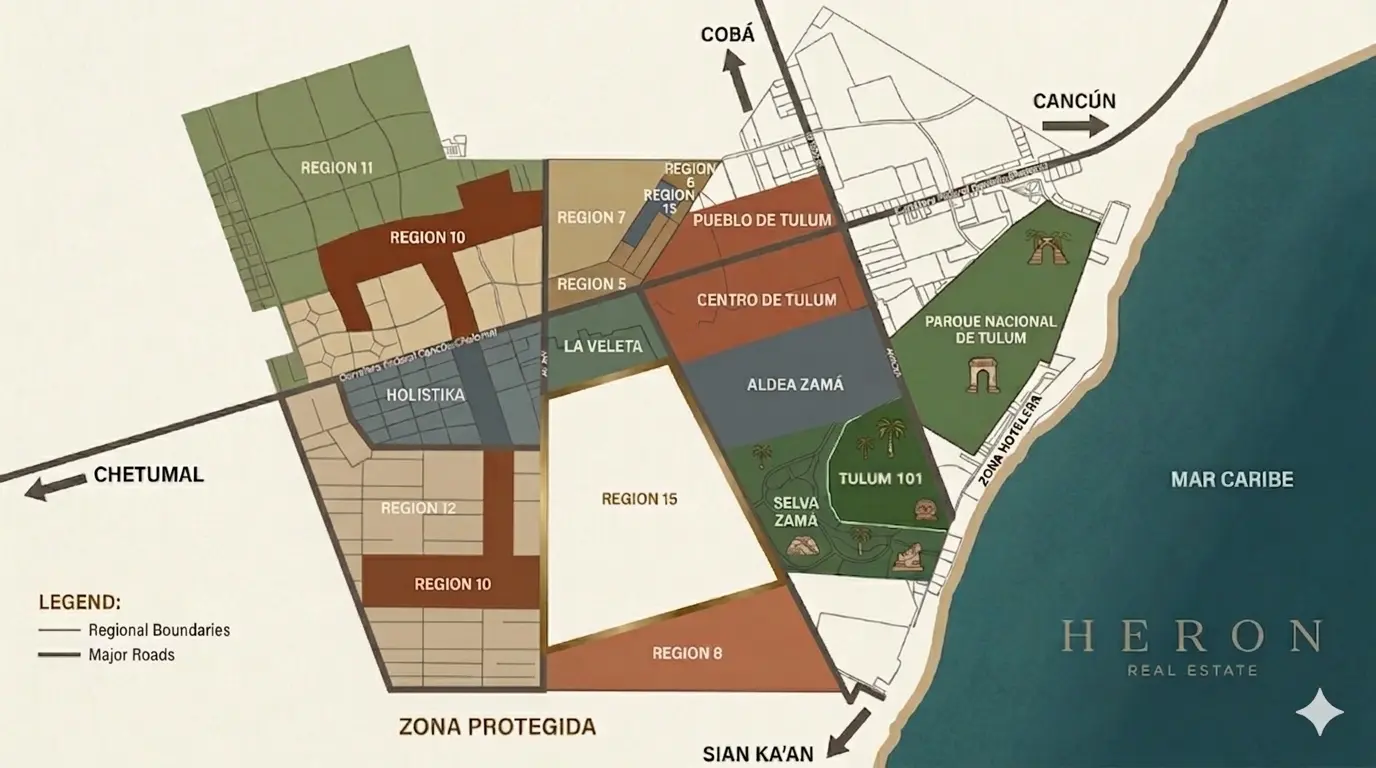
Region 15 is a planned residential zone in Tulum, located along the city’s westward expansion corridor. It sits inland from Tulum’s beach road and south of the town center, with direct road access to both the main commercial arteries and the coastal zone. Administratively, it falls within the municipality of Tulum, Quintana Roo, and its land use is governed by the city’s urban development program (Programa de Desarrollo Urbano).
The zone is designated primarily for medium-density residential development under H2 zoning classification. This means it permits single-family homes, multi-unit villas, and boutique residential buildings with a ground floor plus two levels above — what Mexican zoning calls three niveles — with defined limits on ground footprint (COS), total buildable area (CUS), and minimum permeable green area (CAS).
How did Region 15 come to exist?
Tulum’s growth has been rapid and largely unplanned at its edges. The zones that are now considered established — Aldea Zama, La Veleta, Holistika — were themselves emerging areas a decade ago, developed incrementally as demand from international buyers and digital nomads pushed the city’s residential footprint outward from the beach corridor.
Region 15 is one of the latest chapters in that expansion. As Aldea Zama became built out and La Veleta transitioned from affordable to mid-market, the westward corridor opened up. Region 15 sits at a point in that corridor where the urban grid is defined and lot parcels are registered, but where roads and infrastructure are still being built out and the majority of development has not yet happened. That combination of an established framework and genuine vacancy is precisely what makes it interesting to buyers and developers today — and also what requires buyers to enter with clear expectations about the current state on the ground.
Where exactly is Region 15 and what is around it?
Region 15 is positioned approximately 10 minutes by car from Tulum’s beach corridor and a similar distance from the town center. It is bounded by Tulum’s main road network, which connects it directly to the Federal Highway 307 — the arterial road running the full length of the Riviera Maya from Cancún to Chetumal.
The surrounding area is a mix of completed contemporary residential projects, ongoing construction, vacant lots, and the beginnings of small commercial activity — coffee shops, convenience stores, and local services that follow residential density as it builds. The Tren Maya station in Tulum is accessible from the zone, which connects residents to Playa del Carmen, Cancún, and the broader Yucatán Peninsula by rail.
Proximity to Parque Nacional Tulum — one of the Yucatán’s most significant protected natural areas — adds long-term environmental context to the zone. Development in the immediate vicinity of the park is restricted, which limits supply in the southern approach corridor and reinforces the value of land that already has residential zoning and infrastructure.
How does Region 15 compare to Aldea Zama and La Veleta?
This is the question most buyers ask, and it is the right one. The Tulum residential market has developed in recognizable phases, and understanding where Region 15 sits in that sequence is the core of the investment case.
Aldea Zama was Tulum’s first planned residential master community. It attracted early buyers at low entry prices, consolidated rapidly, and is now a mature neighborhood with established infrastructure, high demand, and prices ranging from $1,800 to $2,500 USD per m² for quality product. It is largely built out. New inventory is scarce and priced accordingly.
La Veleta followed a similar trajectory. Five years ago it was considered emerging and underpriced. Today it is one of Tulum’s most recognized residential addresses, with a developed commercial strip, consistent rental demand, and prices that reflect its established status. The appreciation window that early buyers benefited from has largely closed.
Region 15 is where La Veleta was approximately four to five years ago. Infrastructure is being built in the realtime. Contemporary residential projects are under construction and completing. Land costs and finished product prices remain meaningfully below the established zones — currently averaging $256 USD per m² for land and $1,065 to $1,200 USD per m² for finished villas, compared to $1,800 to $2,500 USD per m² in Aldea Zama. That gap is the investment thesis.
The question is not whether Region 15 will appreciate — the trajectory of every comparable zone in Tulum suggests it will. The question is how quickly, and whether the buyer is entering early enough to capture the majority of that movement.
What is driving demand in Region 15 right now?
Several forces are converging in Region 15 simultaneously, which is what distinguishes it from other emerging zones that have remained peripheral.
Infrastructure investment is the first. Paved roads, urban lot registration, and proximity to the Tren Maya station mean the zone does not carry the uncertainty risk that earlier Tulum expansion zones did. Buyers are not betting on infrastructure arriving — it is already there.
Developer activity is the second. Contemporary residential projects — single-family villas, small boutique developments, and multi-unit configurations — are actively completing in Region 15. That activity signals developer confidence in the zone’s absorption rate and brings finished inventory to buyers who do not want to build from scratch.
Buyer profile evolution is the third. The Tulum buyer of 2026 is more sophisticated than the speculative pre-construction buyer of 2021 to 2023. They are looking for finished product, clear title, and realistic rental yield or appreciation potential. Region 15 offers all three at a price point that is no longer available in the established zones.
Finally, the correction in Tulum’s condo segment between 2024 and 2025 — which saw prices drop 10 to 15% from their 2023 peak — has redirected buyer attention toward the villa and land segments, where price resilience has been stronger. Region 15, with its predominance of villa product and residential land, has benefited directly from that reallocation.
What type of buyer is Region 15 suited for?
Region 15 is not for every buyer. It is suited for three specific profiles.
The first is the investor with a three to seven year horizon who is seeking capital appreciation rather than immediate high-yield rental income. The zone’s appreciation potential is genuine but it requires patience — this is not a beach-adjacent condo that rents at peak occupancy from day one.
The second is the developer or builder who wants to acquire land in a zone with clear zoning, paved road access, and active demand, and build product for sale or rental. At $256 USD per m² for land with up to 2,690 m² of buildable area under H2 zoning, the development economics are compelling compared to any other Tulum zone with comparable infrastructure.
The third is the end-user buyer — typically a foreign national or Mexican professional — who wants a permanent or semi-permanent residence in Tulum at a realistic price point, in a neighborhood that is becoming rather than already become. For this buyer, Region 15 offers the Tulum lifestyle and proximity without the premium of the established zones.
What should buyers know before purchasing in Region 15?
Title clarity is essential. As with any purchase in Tulum’s newer expansion zones, buyers should conduct thorough due diligence on land registration, folio real, and municipal zoning classification before signing any agreement. Region 15 has a mix of clean-title, properly registered parcels and lots that require additional verification — working with a qualified notary and real estate attorney is not optional.
Zoning confirmation matters. H2 residential zoning governs the majority of Region 15, but individual parcels vary. Confirming the specific COS, CUS, height limits, and permitted uses for any given lot before purchase protects the buyer’s development or use plans.
On height limits and what you see being built.
Tulum’s Municipal Construction Regulation establishes a maximum of three niveles and 12 meters for residential buildings. For North American buyers, it is worth noting that Mexican zoning counts floors differently: three niveles means a ground floor (planta baja) plus two floors above it — the equivalent of what most Americans or Canadians would call a three-story building. That is the permitted ceiling in Region 15 under H2 zoning.
Buyers will notice some projects in Region 15 that appear to exceed this. Some use rooftop terraces and penthouse volumes above the second upper floor, which can remain within technical compliance when designed carefully. Others are operating without complete permits or in excess of what was authorized. Tulum’s construction boom — permits issued in the municipality jumped from 34 in 2016 to over 1,200 in 2019 — outpaced regulatory oversight significantly, and the state government has since issued formal alerts about developments operating without required authorizations. For any project presenting more than a ground floor plus two levels above, buyers should request permit documentation and verify it directly. It is a straightforward due diligence step that protects against title complications, fines, and regularization costs down the line.
Infrastructure is present but developing. Paved roads and urban grid are in place, but commercial density and services are still building out. Buyers should calibrate their expectations accordingly — this is a neighborhood in formation, not a finished community.
The Heron Real Estate perspective
Region 15 represents the most accessible entry point into the Tulum residential market for buyers who missed the early windows in Aldea Zama and La Veleta. Infrastructure is being built out in real time, the development trajectory is visible, and the price gap relative to established zones remains wide enough to justify the position. It will not remain wide indefinitely.
Heron Real Estate currently advises on both finished villa inventory and development land in Region 15. For buyers considering the zone, the conversation starts with understanding what you are trying to achieve — and whether Region 15’s specific profile matches that objective. That is a conversation we are equipped to have in depth.